At the end of tiny road, after another one of those roundabouts, lays a spectacular garden, then an abandoned castle, then a huge German bunker, then the Orangerie and finally, what I am really impatient to visit: the Mémoire de Soye two “baraques,” the French one — the 534-10 — and the American one — the famous UK100 we also had in the UK (about 8,000 were imported from America in 1946). I am amazed by all the work Mémoire de Soye has put in the dismantling of the prefabs, their re-assembling on a land which used to count 286 of them till 1991 when the last ones were pulled down! Then they transformed the two prefabs into wonderful cosy and cute museums, trying hard and succeeding in finding the right pieces of furniture, the memorabilia etc…
Article from www.theaccidentalphotographer.me/…
Also art-utile.blogspot.com/…
[sharethis]
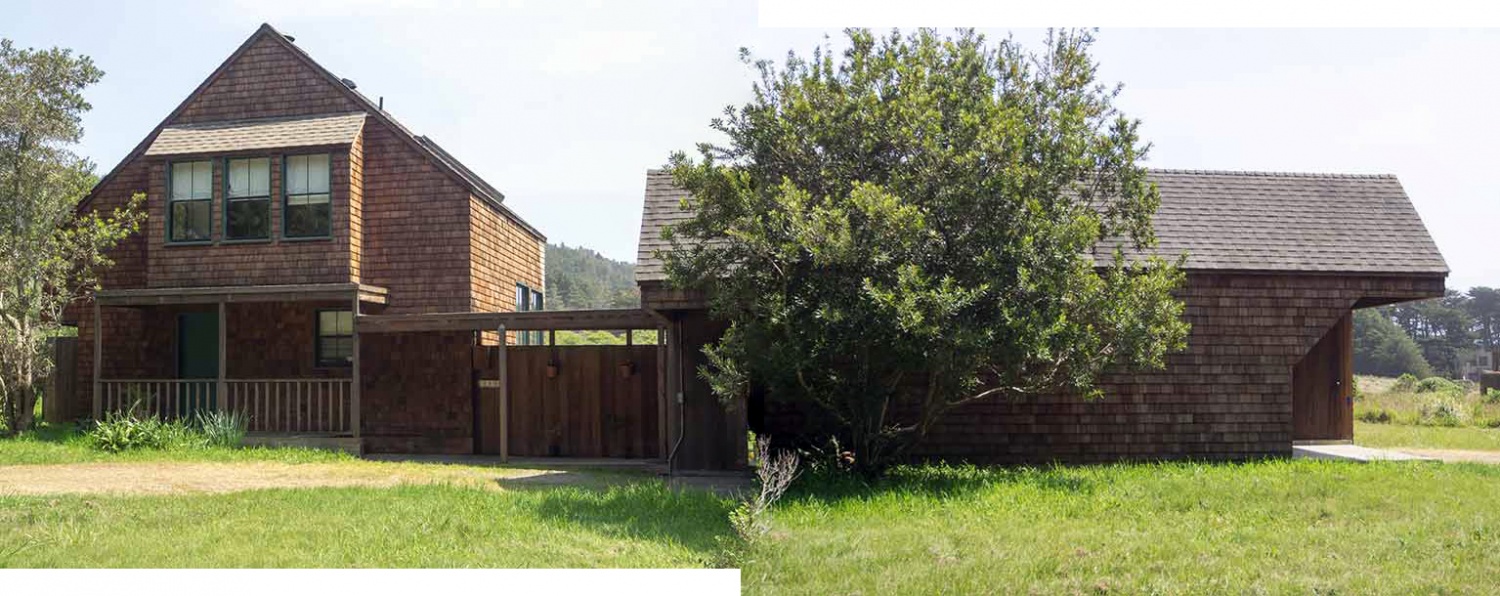
On the Skagg’s Springs Road in Mendocino County, California, last Friday. This is one of those humble farm buildings that stop me in my tracks. Everything looks right. Too bad architects so seldom incorporate the beauty of simplicity, practicality, and economy in their creations.
From www.lloydkahn.com/…
[sharethis]
[sharethis]
Just came in for our new book Small Homes:
Hey Lloyd,
Like many others, your books inspired us to build our own home. Four years ago I left a career as a helicopter pilot in the Army with my wife and two kids and moved to the Mission Valley of Montana (north of Missoula). We bought 40 acres of bare hay fields and built an 800 sq. ft. house. It was quite an experience since neither one of us had experience with construction. We broke ground in late September, and six weeks later I remember the first snow of the season blasting me in the face as I dried in the last wall. We finished it more or less over the winter, then went on to build a barn a few years later … still working on that one!
We grow organic produce and pastured hogs and like to farm as much as possible with our draft horses. I’d like to say 800 sq. ft. is working for us, but after four years, we currently are in the midst of adding on, increasing our square footage to about 1800*. With our remodel, we are trying to replicate the classic American Foursquare style of architecture that is widely seen across the country with a few timber-framed details here and there. I think we could have lasted longer with a house sized somewhere in between, but this was initially going to be just a small cottage for family to stay in and down the road we would build another house, therefore we built it without storage in mind. Well, we ran out of money and didn’t see the need to do that, so here we are! Nevertheless, its been a wild ride!
Thanks for the inspiration!
–Micah & Katie Helser
Yes, it’ll exceed our size limit of 1200 sq. ft., but it was smaller to start, so it’s going in the book. (We have been known to stretch parameters.)
From: www.lloydkahn.com/…
[sharethis]
Hey Evan, I thought you and the rest of the Shelter team might get a bang out of a project I’m finishing up.
My inspiration for this tiny shelter was of course J.R.R. Tolkien’s books and his description of the shire the homeland of the Hobbit. I also drew from my fascination with small wooden sailboat cabins. Intended to go in my living room to act as a reading/napping nook next to a fireplace. I believe foolishness is a much neglected feature in modern design. The act of not taking yourself to seriously is an art and I intend on surrounding myself with it.
–Tohner Jackson
For more info and foolishness, check out:
www.instagram.com/onetreewoodwork
Thanks Tohner, looks great!
Read More …
[sharethis]
I’m rolling with layout of Small Homes. It’s like magic: I start with a bunch of photos and columns of text and start assembling. I’ll pick a lead photo and blow it up on my little (inexpensive) 6-year-old Brother DCP-9040CN color printer/copier and start laying things down, getting pics to size on the copy machine, shifting stuff around, adding text, taping it down with Scotch removable tape and voila, it’s lookin pretty good.
Note: We want to hear what people are doing about shelter in cities (other than paying $3500/month for a studio apartment in San Francisco). Email us at smallhomes@shelterpub.com.
Read More …
[sharethis]
I don’t care for most Sea Ranch architecture. Too sterile, and no overhangs, which is just dumb here on the west coast. Landscaping at Sea Ranch, by Laurence Halprin, however, is brilliant; he just left everything as was, coyote bush and all.
This house, however, looked good to my eye.
From www.lloydkahn.com/…
[sharethis]

My first building in 1961, in Mill Valley, California, a studio with what is now called a “living roof”
I actually started building in 1960 and soon thereafter started shooting photos and interviewing builders for our series of books on handmade housing. In those days we didn’t call it “natural building,” but that’s what it was. In our book Shelter in 1973, a section of the book was devoted to these materials: wood, adobe, stone, straw bale, thatch, and bamboo. I guess we were natural before it was called “natural.”
A month or so ago, Cheryl Long, the editor at The Mother Earth News, asked me if I could do a talk on natural building at the TMEN fair in Albany, Oregon (near Corvallis) on the first weekend in June. As I was getting the materials together, the Maker Faire asked if I could do a presentation at their annual event in San Mateo, California, on May 16.
Read More …
[sharethis]
Over the years I’ve made a bunch of tables out of used Douglas Fir. This was made from 3×10s that I got at Caldwell Wrecking in San Francisco.
[sharethis]
One of the most common questions we get asked is “How do I learn how to build a tiny home?” A very superior answer would be the Yestermorrow School in Waitsfield, Vermont offering over 100 hands-on courses per year in design, construction, woodworking, and architectural craft including a variety of courses concentrating in sustainable design and green building. Yestermorrow is one of the only design/build schools in the country, teaching both design and construction skills. Hands-on courses are taught by top architects, builders, and craftspeople from across the country.
Read More …
[sharethis]
I like the way this inexpensive connecting roof provides so much more usable space.
[sharethis]
I’ve shot a whole bunch of these simple little frame structures on Kauai, usually with tin roofs and overhangs, usually resting on foundations of pre-cast concrete pads. I’ll get around to posting a bunch more later. They make sense in terms of simplicity, economy, ease of construction, and local climate.
[sharethis]