Deek’s Brockton, MA Hands‑On Tiny House Building Workshop 2016! Our workshops are fully hands-on, taught by a duo who have hosted and designed for HGTV and The DIY Network, have been featured in the New York Times, and are so fun and eclectic, that we have many people who have attended these workshops two, three, and even four times!
FEBRUARY 5-6-7, 2016, Brockton, MA (25 min. from Boston)
Well, its pretty thrilling that a museum that I hold in high esteem, and one that is gorgeous, has asked us to host a Hands‑On Tiny House Building Workshop! Naturally we said yes! This time around, we have more space than we know what to do with, all indoors (don’t worry, you won’t freeze to death!), and we’ll be tackling two, if not three, tiny cabin and shelter projects — all roping in the know-how you need to build a tiny house, shed, tree house, cabin, or funkified fort!
Tiny home may not be much but it could mean the world to some.
“If you ride along in Wheeling, you see a bunch of homeless people. In the winter time I’m sure they are freezing and I know the Salvation Army helps but I know some of these people want their own home,” said Howard Scott, owner of Scott’s Home Construction in Wheeling.
The average tiny home measures 8 feet by 20 feet and comes equipped with a loft for a bed. The humble abode Scott’s Home Construction plans to build would be energy-efficient, meaning it would be cost-efficient — perfect for their target clients.
Encompassed by her warm orange walls decorated with vivid art, Carrboro Board of Aldermen member Bethany Chaney said living in a home with a footprint of only 400 square feet was an experiment at first. “The things I have make me happy, and I don’t need to constantly acquire things to fill up room that I don’t use. I use every bit of space in this house,” she said. Chaney, a resident of Carrboro, is not alone in the quest to live on less.
The size of your home has a tremendous influence on your cost of living, environmental impact, and general well-being. The demand for space-efficient housing continues to grow exponentially as people of all ages discover that a smaller home might be the key to a larger life.
That’s why leading designers, builders, developers, realtors, policy makers and community members will gather for the Build Small Live Large 2015, a unique, one-day housing summit, to share what’s working, what’s new, and what’s next. Alan Durning from the Sightline Institute and tiny house pioneer Dee Williams will lead off the day with inspiring keynote speeches about how building small can lead to broader community action and how positive change really does begin at home.
Join us to learn how to build and rent out a backyard apartment, see successful examples of cottage clusters and small house communities, and become inspired by space-efficient and energy-efficient designs. End the day with an energizing look at the beautiful and inventive small spaces in the “Best of Small” Design Slam, and network with pioneering builders and designers of small houses throughout the event! Find out more at: Build Small Live Large Summit 2015.
–Dee Williams
Portland Alternative Dwellings
Build the life you dream … TODAY!
At the end of tiny road, after another one of those roundabouts, lays a spectacular garden, then an abandoned castle, then a huge German bunker, then the Orangerie and finally, what I am really impatient to visit: the Mémoire de Soye two “baraques,” the French one — the 534-10 — and the American one — the famous UK100 we also had in the UK (about 8,000 were imported from America in 1946). I am amazed by all the work Mémoire de Soye has put in the dismantling of the prefabs, their re-assembling on a land which used to count 286 of them till 1991 when the last ones were pulled down! Then they transformed the two prefabs into wonderful cosy and cute museums, trying hard and succeeding in finding the right pieces of furniture, the memorabilia etc…
I’m going to post sneak previews of our next book, Small Homes, once in a while, as I proceed with layout. There will be 6 pages with photos of Mark and Meg’s home, built out of recycled wood, and garden.
I’m experimenting with Twitter to post references to other websites; it’s quicker than blogging. www.twitter.com/lloydkahn
I started 3 days ago. My M.O. is to open the file drawer and start picking out folders (there are 50–60 now) to work on.
I pick them out randomly and start doing layout — with scissors and removable scotch tape. No stinkin’ computers at this stage.
I print out the text in 3 and 4 columns, adjust photos to desired size on copy machine, and do rough layouts.
This is turning out to be really fun. We’ve accumulated material for maybe a year and now, the book is starting to assemble itself, in random manner. Organizing will come later.
Note: Contact us if you know of small homes (400–1200 sq. ft.) that would work in this book: smallhomes@shelterpub.com
We are especially interested in any kind of homes in cities and towns.
I’ve shot a whole bunch of these simple little frame structures on Kauai, usually with tin roofs and overhangs, usually resting on foundations of pre-cast concrete pads. I’ll get around to posting a bunch more later. They make sense in terms of simplicity, economy, ease of construction, and local climate.
“It only cost the Morrisons $22,000 to build their dream home. They now live mortgage-free, which has improved the quality of their life and the closeness of their marriage. Thanks to a brilliant design, this 207 sq. ft. space feels much bigger on the inside. The Morrisons have everything they need. There’s a spacious kitchen, with an oven, fridge, and sink. Definitely no lack of counter and shelf space here! They also included a reading area and an office desk that doubles as a dining table. Under the stairs to the loft is a big ‘closet.’ Not a single inch is wasted.”
There are two things that I like about this tiny home:
The light coming in from all around — no claustrophobia as with many tiny homes.
The bed is not in a cramped loft, as with many tiny homes. (The vertical ladders to these lofts make them doubly poor in design.)
This place is plain and simple on the outside, and thoughtfully laid out on the inside.
Brian Levy is leading his own quiet experiment on a pie-shaped, 5,000-square-foot lot in Northeast Washington. As new homes get larger and larger in many neighborhoods throughout the region, Levy is attempting to prove that less is more.
Levy’s house is 11 feet wide and 22 feet long, with 210 square feet of interior space. The house has a galley kitchen and space to accommodate a small dinner party. It also has a full-size bed — although he can’t sleep overnight there because of a provision in District law.” Read More …
Stefan’s home measures just 215 square feet and his main aim when building it was to create a comfortable home while keeping the building costs down. While the home is sustainable, Stefan does not consider himself a dedicated greenie or tree hugger. He simply did what he had to given the circumstances. Repurposing materials to create a home is at the heart of any sustainable living endeavor. The tiny home recently built by Stefan Cook of A Biggish Tiny House is a prime example of repurposing and salvaging building materials done right. He’s a resident of Christchurch, New Zealand, which experienced devastating earthquakes in 2010 and 2011. Stefan salvaged the materials left behind by the devastation to build his own tiny home and recently gave a tour of it at Living Big in a Tiny House. Read More …
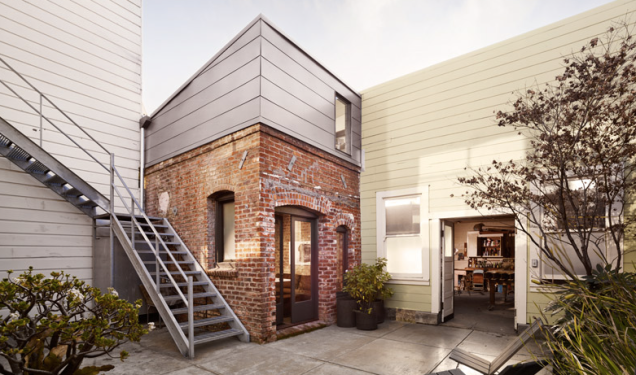
There’s residential design, and then there’s jigsaw puzzle design. This elegant project by the San Francisco architect Christi Azevedo, who wedged a full guest house into a laundry and boiler room from 1916, falls somewhere in between the two. Read More …
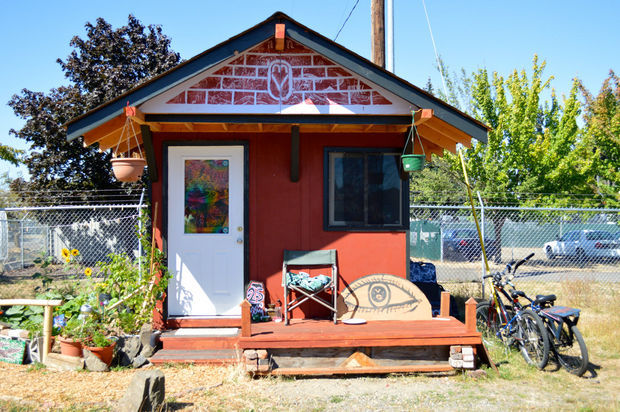
There is no electricity or plumbing, but the front doors can be locked for privacy and the modular, simple structures keep the rain, wind and chill away. A tenant can personalize the 80-square-feet space. Many have sleeping lofts over the kitchen/desk area. A few have painted the plywood walls.
Residents share a communal kitchen, bathrooms, showers and gathering space.
“Take a 1901 barn, a 1923 farmhouse, and a student who needs an architectural project and you get the opportunity to own a unique two-piece tiny house. Come up with $23,000 and a way to move the project from its home in Olympia and you support a student with ideas while also being green and eco. At 256 square feet, the price per square foot isn’t too bad, either. There must be a catch.
Some assembly required. The house is a student project, an incomplete student project. The most important parts are finished, or at least enough of the exterior has been completed to protect the building and the interior. As for the interior, the hardwood floor, bathroom sink, and “other bits” are in; but you may want to check on the kitchen, the rest of the bathroom, any cabinetry, lighting, plumbing, heating, etc. Details, details…”
In 1973 we published Shelter, which turned out to be station central for people interested in creating their own homes. Now, in the 21st century, we continue this dialog here online on shelter, carpentry, homesteading, gardening, and the home arts with this blog. We hope you will join us and contribute.

Deek’s Brockton, MA Hands‑On Tiny House Building Workshop 2016! Our workshops are fully hands-on, taught by a duo who have hosted and designed for HGTV and The DIY Network, have been featured in the New York Times, and are so fun and eclectic, that we have many people who have attended these workshops two, three, and even four times!