Tiny Texas Houses were featured in our book Tiny Homes: Simple Shelter. Here are examples of more of their work. All materials salvaged. “For us, a Tiny House runs a 160 sq. ft. up to about 750 sq. ft., including the lofts and an insulated back porch. The Teeny Tiny House is generally under that mark on the bottom floor, going as low as 63 sq. ft. Here are a few of the tiniest houses that we have built that are great for a guest house, or for a child living at home that you do not want to become totally independent of the main house. Here are some of my favorite Teeny Tiny Houses that we have created so far.”
“…They live and work in this 120 sq. ft. cabin in the mountains of Asheville. Inside you’ll find a storage loft, sleeping loft, open living/dining area, bathroom with composting toilet and manual pump shower, and a kitchen…”
“Imagine living in a place with your possessions, all within a 232-square-foot house. For one thing, you’ll probably need a lot fewer possessions. But Denise Ryals, who builds tiny homes with her husband, Tommy, said a buyer can pack their possessions — and the house itself — and drive it anywhere…”
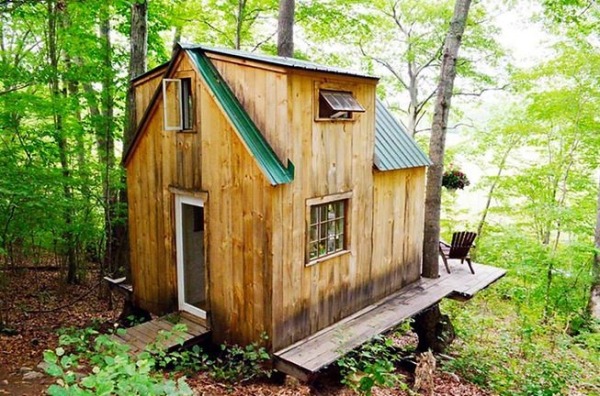
“This 11′ by 14′ tiny cabin in the woods was built by carpenter Dave Herrle for only $4,000 in about 6 weeks. He used as much salvaged materials as he could find to complete it and was deeply inspired to create a simple way of life. After graduating from college Dave got a desk job that he did not enjoy. In 2007 he hiked the entire Appalachian Trail when he was 27 years old and it absolutely changed his outlook on life. He knew he had to make some changes. The hike gave him the perspective on living simply that he needed to make a positive change in his life. In his words, ‘It was in the woods that I promised myself that I wouldn’t spend a lifetime doing a job I didn’t enjoy…’ ”
“All models of the Portable Cedar Cabins are custom-built. We will work with your budget to build the cabin of your dreams. All models have a beautiful pine interior with a rich cedar siding. The models are from 144 to 400 square feet. Up to 400 square feet, the cabins are considered a park model or an RV. All Portable Cedar Cabins are inspected and certified like an RV and you will be given a vin number. If you want a custom-made unit beyond 400 square feet, it is no longer considered an RV. Please refer to the Workhouse Model if you want a larger, custom-built cedar cabin. Dave can also build cedar cabins on skids…”
“…as a tribute to the alpine experience and the famed writer, Swiss studio Bureau A has sited their project ‘Antoine’ within the vast, mountainous expanse of the Alps. commissioned during an artist residency at the Verbier 3D Foundation, the architecture-cum-sculpture is inhabitable and structurally functional, comprising an indoor cabin with a fireplace, bed, table, stool and window. literally hanging on the rock-fall field, the small wooden dwelling hides its internal features within a projected concrete rock, deriving its shape from natural elements in its surrounding environment…”
The thriving tiny home movement is a double-edged sword for companies selling their vision of small living, as it’s tougher than ever to stand out from the crowd. Oregon City–based small home firm Heirloom aims to get noticed with a luxurious off-grid tiny house on wheels that boasts an excellent finish and more amenities that you might expect, considering its size. In addition, an interesting automated house control system that’s controlled via an iOS or Android smartphone will soon be available at extra cost too.
Stefan’s home measures just 215 square feet and his main aim when building it was to create a comfortable home while keeping the building costs down. While the home is sustainable, Stefan does not consider himself a dedicated greenie or tree hugger. He simply did what he had to given the circumstances. Repurposing materials to create a home is at the heart of any sustainable living endeavor. The tiny home recently built by Stefan Cook of A Biggish Tiny House is a prime example of repurposing and salvaging building materials done right. He’s a resident of Christchurch, New Zealand, which experienced devastating earthquakes in 2010 and 2011. Stefan salvaged the materials left behind by the devastation to build his own tiny home and recently gave a tour of it at Living Big in a Tiny House. Read More …
Although we featured this shed earlier this year, here is an article with more information and better pics.
Carpenter, painter, musician and sculptor Joel Bird started working on his garden shed four years ago. “It was like an experiment, really,” Bird says. He’d finished renovating the house he’d bought in Tottenham, north London, and he wanted to create a serene and functional workspace in which he could produce music and paint. In addition to a workspace, he also wanted a garden, so he designed his shed with a garden on the roof. Over the past four years, the roof garden has become more and more elaborate, with a raised bed for vegetables, solar panels and an efficient drainage system. Read More …
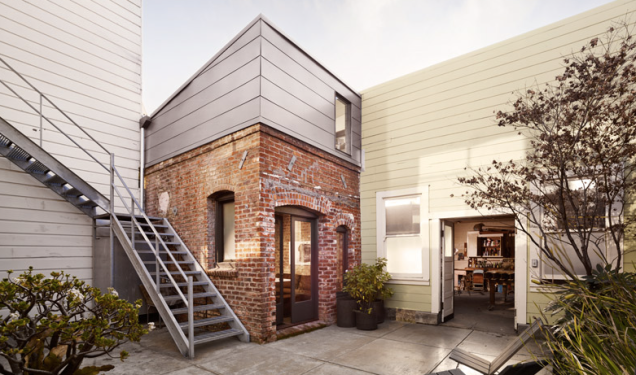
There’s residential design, and then there’s jigsaw puzzle design. This elegant project by the San Francisco architect Christi Azevedo, who wedged a full guest house into a laundry and boiler room from 1916, falls somewhere in between the two. Read More …
An Austin professor has spent the better part of 2014 living minimally in a space that’s not as trashy as it sounds: a dumpster. The Dumpster Project — an ongoing project spearheaded by Jeffrey Wilson, an associate professor of biological sciences and dean of the University College at Huston-Tillotson University in Austin — aims to see how humans can live in a comfortable but environmentally sustainable fashion. “If you think about just moving to a smaller space and having less stuff, it creates some voids or spaces in your life that you can fill up with more meaningful stuff, meaningful experiences,” said Wilson, who has been nicknamed “Professor Dumpster”…
The prolific Jay Nelson has just completed a new vehicle. Jay’s nomadic creations are in both Tiny Homes and Tiny Homes on the Move. Here’s how he describes his latest:
Golden Gate 2, named after the last electric camper I built, Golden Gate 1. It’s a car camper made with salvaged wood and bike parts. It has a 90″ × 42″ footprint. Sink, water tank, stove, cooler. The entire inside is a bed.
Here is a collection of some of the most breathtaking bridges from around the world, all built from natural materials. Check out the rest of the images at www.boredpanda.com/old-mysterious-bridges.
In 1973 we published Shelter, which turned out to be station central for people interested in creating their own homes. Now, in the 21st century, we continue this dialog here online on shelter, carpentry, homesteading, gardening, and the home arts with this blog. We hope you will join us and contribute.