Renée’s kitchen built of driftwood, Northern California, 1970s
Photo by Lloyd Kahn
From our Tumblr

Renée’s kitchen built of driftwood, Northern California, 1970s
Photo by Lloyd Kahn
From our Tumblr

Scarf joint in barn on Cape Cod, Massachusetts
Photo by Lloyd Kahn
From our Tumblr

A kitchen on Lasqueti Island built by an old carpenter named John. The whole house is very original — many curved doors.


This is Jay’s cabin, on a little island near Seattle, it’s like a hobbit house — buried under the dirt with a large south window. He lives on this land with his sons. Beautiful garden, see view. Secret place the civilization with Barbie concrete homes are being built around the land.


This is our funny USA building in Humboldt County. Menthé and I built it in about 10 days.
We used old first-growth cedar for the frame and old yellow shakes for the roof. The timber is a mix between French and American techniques; the low wall in shingles and the high wall in colombage. The roof is curved like the “Philibert Delorme roof”; we didn’t use a lot of wood to make the curve because we screwed the inside of the plank on to the top of the curve, a cheap beautiful technique.
The upper little roof is where you can watch from the bedroom mezzanine — just for fun. The gypsy Dodge does not have a motor, so it needs to be moved with a tractor on the property. It’s a friend’s bedroom, 6 ft. high!!!!!!

This is my friend Travis in Olympia. He made this trailer for $7,000. He lives in it full time so he can move it when he wants. He is an excellent wood carver as well as a metalworker.
 Our French carpenter friends Yogan and Menthé spent several months last summer, hitchhiking up and down the Northwest Pacific Coast and trading their carpentry skill for room and board.
When they left, they visited us here and we downloaded about 1,000 of their photos. They’d had a great trip.
They wrote: “The U.S.A. is incredible, so much imagination. It was a perfect trip for me. Thank you Lloyd, I wanted to meet the amazing builders of the pacific coast. Your book Builders of the Pacific Coast was my motivation for my trip to the West Coast.”
I picked out a few photos and Yogan has written these captions. We’ll post them one at a time.

The Leviathan Studio on Lasqueti Island. Mark is a contemporary dancer who built this studio by himself. He used trees from his 12½-acre property. The south side was made with used windows; the floor is yellow cedar. The roof is green: he used EPDM roofing. It’s built it for dance workshops during the warm season. The architecture is inspired by Leonardo Da Vinci.
Deek’s Brockton, MA Hands‑On Tiny House Building Workshop 2016! Our workshops are fully hands-on, taught by a duo who have hosted and designed for HGTV and The DIY Network, have been featured in the New York Times, and are so fun and eclectic, that we have many people who have attended these workshops two, three, and even four times!
FEBRUARY 5-6-7, 2016, Brockton, MA (25 min. from Boston)
Well, its pretty thrilling that a museum that I hold in high esteem, and one that is gorgeous, has asked us to host a Hands‑On Tiny House Building Workshop! Naturally we said yes! This time around, we have more space than we know what to do with, all indoors (don’t worry, you won’t freeze to death!), and we’ll be tackling two, if not three, tiny cabin and shelter projects — all roping in the know-how you need to build a tiny house, shed, tree house, cabin, or funkified fort!
More info at relaxshacks.blogspot.com/…

From our Tumblr
Photo by Lloyd Kahn
During my bookstore tour in Oregon in June, I took a few days off to drive around in the Willamette Valley (south of Portland) to hunt for barns. It’s a beautiful area, kind of like a mini-Sacramento Valley — flat, rich farmland, abundant water, with steep mountain ranges on 3 sides. I spotted this barn with it’s gracefully curved roof and did my usual trespassing to shoot the exterior.
Read More …

Photo by Lloyd Kahn
Lloyd Kahn’s home, built in 1967 at Burns Creek, Big Sur, Calif., out of recycled lumber and hand-split redwood shakes.
I met Mike B. when we started working on the Tiny Homes and Tiny Homes on the Move books. Amazing builder, snowboarder, traveller. This guy does it all, one of the most inspiring people I know. Here is a newly released video by GoPro and him detailing the build and trip to Alaska.

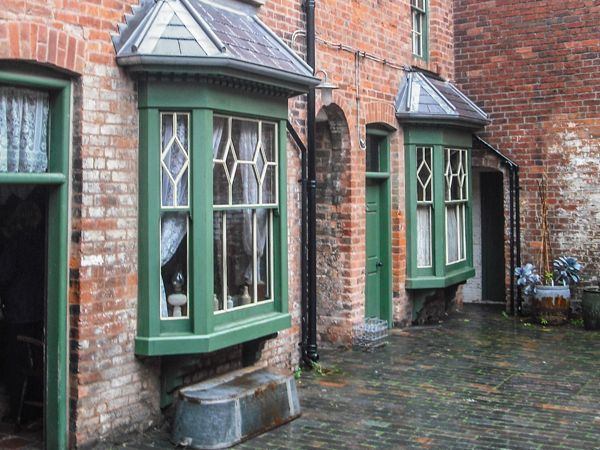
Situated just behind New Street Station, the Birmingham Back to Backs are nestled in the very heart of Birmingham and are a residue of the history of the city’s population over the past 150 years.
The Back to Backs were originally tiny houses literally built back to back to each other in different quarters. Within these quarters communities would form. They were built in the 1800s in order to provide homes for the ever increasing population of the Birmingham of the Industrial Revolution. The Back to Backs were still inhabited by residents until the 1960s and 1970s when most of the courts were demolished to make way for more modern accommodation. 10 years ago the National Trust acquired the city’s very last surviving court of Back to Back buildings and has been preserving them ever since, much to our advantage.
From www.redbrick.me/…
Photo from: www.britainexpress.com/…
Photos of Back-to-Backs: www.google.com/…

Round roof barn in Willamette Valley, Oregon
There are buildings that have — for lack of a better word — a sweetness to them. Like a small abandoned cottage in an English field I once found, slowly disintegrating back into the soil from which all its materials came. Inside, I could feel the lives that had been lived there. Or the buildings of master carpenter Lloyd House. It happens most frequently in barns, where practicality and experience create form with function. No architects needed, thank you.
Read More …
“I like to tell people what I see going on in the world…”
Last April, Shelter was visited by Yuichi Takeuchi, an artist, carpenter and treehouse builder from Japan.
Yuichi said he’d been heavily inspired by our book Shelter. He was making a movie called Simplife and wanted to interview Lloyd. Here’s a preview.

From www.lloydkahn.com/…
Send us material (photos and text) for The Shelter Blog.