I started 3 days ago. My M.O. is to open the file drawer and start picking out folders (there are 50–60 now) to work on.
I pick them out randomly and start doing layout — with scissors and removable scotch tape. No stinkin’ computers at this stage.
I print out the text in 3 and 4 columns, adjust photos to desired size on copy machine, and do rough layouts.
This is turning out to be really fun. We’ve accumulated material for maybe a year and now, the book is starting to assemble itself, in random manner. Organizing will come later.
Note: Contact us if you know of small homes (400–1200 sq. ft.) that would work in this book: smallhomes@shelterpub.com
We are especially interested in any kind of homes in cities and towns.
[sharethis]
A submission for our Small Homes book.
Hello,
For consideration in Small Homes.
Northwest Washington: 940 sq. ft. octagonal cedar home featuring wrap-around deck, open floor plan, natural lighting, wood heat, domestic rainwater catchment system, composting toilet, all-wood interior and non-toxic construction. 1 bed, 1 bath. Separate 96 sq. ft. guest cabin/bedroom.
–Mark & Ruthie T-K
Read More …
[sharethis]
Sent to us by Conor McBrierty :
A young family is making a last-ditch effort to save its cherished “hobbit house” from the bulldozers after planners deemed it had to be razed.
Charlie Hague and Megan Williams used natural materials to lovingly build their roundhouse tucked away in southwest Wales. But the pair, both 27, applied for planning permission only after moving in with their newborn son, Eli, in 2012.
Though many local people did not even know the small building was there, planners ruled the house did not fit in with the surrounding Pembrokeshire countryside and decided it had to go.
Read More …
[sharethis]
Last week, I did a slide show on Tiny Homes on the Move at the –William Morris
And working with our own hands.
Read More …
[sharethis]
One of the most common questions we get asked is “How do I learn how to build a tiny home?” A very superior answer would be the Yestermorrow School in Waitsfield, Vermont offering over 100 hands-on courses per year in design, construction, woodworking, and architectural craft including a variety of courses concentrating in sustainable design and green building. Yestermorrow is one of the only design/build schools in the country, teaching both design and construction skills. Hands-on courses are taught by top architects, builders, and craftspeople from across the country.
Read More …
[sharethis]
I’ve shot a whole bunch of these simple little frame structures on Kauai, usually with tin roofs and overhangs, usually resting on foundations of pre-cast concrete pads. I’ll get around to posting a bunch more later. They make sense in terms of simplicity, economy, ease of construction, and local climate.
[sharethis]
This reminds me of homes designed by Bernard Maybeck and Julia Morgan during the Arts and Crafts Movement in the San Francisco Bay Area in the early 1900s. Note the fine lava rock masonry work of the fireplace, the gentle curves at the ends of the rafters. Well designed, well built.
[sharethis]
I recently spent three weeks on the island of Kaua‘i. I shot a lot of photographs of small homes that seemed simple, well-designed, and suitable for the climate. In general I thought that construction on Kaua‘i was of pretty good quality: good carpentry. I’m going to put up photographs as I get the time. Some of these are more upscale than others, but overall, the shapes seem functional.
When people ask me what I think they should build, I generally suggest that they look around at what’s been built in the neighborhood (or surroundings). I think this is generally a better place to start than with an architect.
Read More …
[sharethis]

Les Tit’B Libres is a group of young French artists living communally in handmade structures, such as this cob home with a reciprocal roof.
See more of their free lifestyle at titblibre.garagepunks.com.
To build a reciprocal roof, we first install a temporary central pillar on which the first chevron is placed. The height of this pillar depends on the roof pitch.The following rafters are then placed to support the one on the other. The last chevron place above the penultimate and below the first one. They are then attached to each other and the central pillar is removed. If only one of the rafters breaks, the whole structure collapses. Read More …
[sharethis]
This is one of my favorite little homes; everything about it seems right. I especially like the way the roof changes angles at the bottom, which directs rain out away from the building; also the shingle pattern above the windows and door makes it look like the house has eyebrows.
It was built by Jeanne-Marie; she based the design on the old stone barns of the surrounding countryside, but used wood rather than stone. The photo is by jean soum (capitalized as written), and it’s featured in our book Home Work in an article entitled “Archlibre,” on countercultural builders in France.
[sharethis]

From Tiny Homes: Simple Shelter
Lloyd Kahn’s book,
Tiny Homes, featured Linda Smiley’s Laughing House, located in Oregon at the
Cob Cottage Company. Linda is a director of Cob Cottage Company as well as a master cobber and therapist. She teaches Sculpting Sacred Spaces, Interior Design, and Natural Plasters and Finishes.
Read More …
[sharethis]
A 1920s shingled creekside cabin redesigned by architect Amy A. Alper.
Description
“The architect designed a new double-height living room addition to wrap the original exterior. Weathered shingles and period windows remain — when open, kitchen and living room are connected. New materials contrast with the old; reclaimed beams mediate between them, and visually echo the surrounding woods. Window walls showcase views to the swirling waters below.” Read More …
[sharethis]
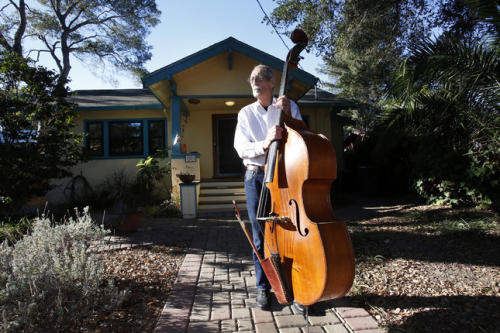
“Two years of tight supply and intense demand have pushed prices for modest Bay Area homes in trendy neighborhoods to mind-boggling heights. In Palo Alto, tiny homes sell for multiple millions of dollars. In Oakland’s sought-after Rockridge district, a home just sold for $500,000 over the asking price. With the price of homes in Palo Alto skyrocketing, Ken Plourde, a 79-year-old retired jazz bass player, decided it was time to sell the home he bought for $35,000 in 1970. “I was sitting on a gold mine,” said Plourde, whose income from music gigs has been declining with his advancing years and changes in the live music business.”
www.insidebayarea.com/…
[sharethis]


 I started 3 days ago. My M.O. is to open the file drawer and start picking out folders (there are 50–60 now) to work on.