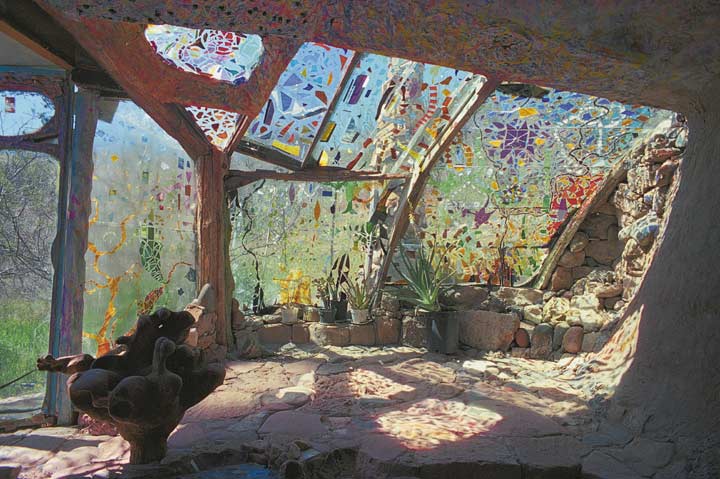
Underhill is an incredible hobbit-home eco-cave house built into a hillside. The off-the-grid house is cleverly constructed to resemble a cave. With no electricity in the house, the stone, wood and rustic features truly make you feel like you’re stepping back in time.
One of the most common questions we get asked is “How do I learn how to build a tiny home?” A very superior answer would be the Yestermorrow School in Waitsfield, Vermont offering over 100 hands-on courses per year in design, construction, woodworking, and architectural craft including a variety of courses concentrating in sustainable design and green building. Yestermorrow is one of the only design/build schools in the country, teaching both design and construction skills. Hands-on courses are taught by top architects, builders, and craftspeople from across the country. Read More …
Just completed another bridge project. This was constructed using a hybrid of laminated plywood, steel, and oak. It’s the first time I’ve experimented with such large laminations!
This is one of my favorite little homes; everything about it seems right. I especially like the way the roof changes angles at the bottom, which directs rain out away from the building; also the shingle pattern above the windows and door makes it look like the house has eyebrows.
It was built by Jeanne-Marie; she based the design on the old stone barns of the surrounding countryside, but used wood rather than stone. The photo is by jean soum (capitalized as written), and it’s featured in our book Home Work in an article entitled “Archlibre,” on countercultural builders in France.
Lloyd Kahn’s book, Tiny Homes, featured Linda Smiley’s Laughing House, located in Oregon at the Cob Cottage Company. Linda is a director of Cob Cottage Company as well as a master cobber and therapist. She teaches Sculpting Sacred Spaces, Interior Design, and Natural Plasters and Finishes. Read More …
I built a cottage for the local suburban farm outside Cleveland, Ohio. It took 2.5 of us and some weekend volunteers about three months to build. It is 200 square feet plus a bump-out window-bed and a 100-square-foot loft. The round poles and lumber came from the firewood pile on the property. We had an Amish miller come out with his trailer band-saw and slice up the bigger logs into live-edge boards for the ceiling and window bucks.
The walls are insulating clay-straw. The windows came from the local Habitat Restore. The interior is plastered with tinted drywall compound. The floor is local clay and stones sealed with hemp oil. The heat source is a small rocket mass heater. The chimney goes back and forth through the clay floor to heat it and keeps the building warm long after the fire is out.
…We used the clay — excavating to dig a swimming pond just behind the cottage. This summer we will do a two-week cottage building workshop at the same site for anyone who wants to learn how to build their own. Email Info@unclemud.com for more information.
Saw your call for responses to the upcoming Small Homes book. Exciting! I think our straw bale & timber frame home fits squarely into that category. It’s actually around 440 sq. feet of interior heated space, but with the porch and balcony it’s a bit bigger.
Here is a collection of some of the most breathtaking bridges from around the world, all built from natural materials. Check out the rest of the images at www.boredpanda.com/old-mysterious-bridges.
Michael “Bug” Deakin grew up in British Columbia, one of 10 kids in the family. He built his first house in 1970 out of used materials and these days runs Heritage Salvage, a large yard in Petaluma, Calif., filled with hand-hewed beams, flooring, barn doors, and all kinds of salvaged building materials. I love roaming around his yard. There are treasures there, as there are in this book.
He’s an irrepressibly dynamic, cheerful, funny guy (disclaimer: I know him) and this is a scrapbook of his colorful world and history. There are stories: building homes, gardens, furniture and movie sets (including for McCabe and Mrs. Miller), planting trees, tearing down old buildings all over America, a touching (and happy) tale of first meeting his daughter when she was 40 and their immediate rapport, of hanging out with Tom Waits.
He’s a dynamo for all good things and this a charming introduction to Bug’s World.
In Tiny Homes, we did two pages (pp. 110-111) on Ziggy Liloia’s cob cottage. In this excerpt from his website, TheYearOfMud.com, he explains how he built his reciprocal framed roof.
A reciprocal roof is a beautiful and simple self-supporting structure that can be composed of as few as three rafters, and up to any imaginable quantity (within reason, of course). Reciprocal roofs require no center support, they are quick to construct, and they can be built using round poles or dimensional lumber (perhaps with some creative notching). They are extremely strong, perfect for round buildings, and very appropriate for living roofs, as well. The reciprocal roof design was developed by Graham Brown in 1987. Read More …
We featured these cabins about a month ago and have repeatedly had requests for some more photos including interior shots. Here are some more shots as well as some info on the builder.
Massey Burke is a designer, builder, and advocate for natural building.
She has also taught natural building and design with various educational institutions, including the University of San Francisco, Swarthmore College, and the Solar Living Institute. Other current projects include permitting a load-bearing cob studio in Berkeley and a natural remodel in El Sobrante. Current work can be found at masseyburke.carbonmade.com. Read More …
In 1973 we published Shelter, which turned out to be station central for people interested in creating their own homes. Now, in the 21st century, we continue this dialog here online on shelter, carpentry, homesteading, gardening, and the home arts with this blog. We hope you will join us and contribute.