I thought you might get a kick out of this “Hippy Shack” I built on the back of a 1988 Toyota pickup. I use it as my ski chalet. It has a 7-foot-long ski locker and a heated boot locker. A domed skylight provides passive solar heat, but it also has a propane heater and a wood-burning stove.… Also a sink and a stove with an oven. Read More …
Portland-based design firm Von Tundra did the conversion of a 1969 Dodge Chinook into a mobile juice and cocktail bar. Their client wanted something a little different to serve street food to the city’s public as well as host guests inside. It went from a bland old white truck to Sip Mobile Lodge, a stylish vehicle that feels right for the American Northwest with its heavy use of wood and comfortable interior. Read More …
I bought it used from a builder friend. It didn’t have the “Xtra cab,” so the bed was 8′ long.
Tarp for Shade: I had a Yakima Rocket Box on racks on the camper roof, with a flea market tarp (12’×14′) folded up inside. The frame was 1″ electrical conduit, with special connectors tightenable with wingscrews. The tarp was aluminized fabric. It was weighted down with canvas bags filled with sand and hung from each corner (ingenious!). Took maybe 45 minutes to set up. I’d place it butting up to the truck bed.
Roof-Top Tent: This was the star of the camping show. It folded up to about 4′ by 4′, 20″ thick, with a waterproof cover. At night I’d remove the cover and fold it out. The tent popped up when this was done, and the mattress and bedding were already there. The outer cantilivered side was held up by a telescoping ladder (more ingeniousness). It was real canvas, had a raincover, mosquito net. On beaches, I’d park with the open end facing the water and sunrise. It was luxurious sleeping up there. This unit was called AirCamping and was made in Italy; they’re no longer in business, but there are a number of truck- (or car-) top campers.
Cooking: I had a sliding drawer in the bed with my cooking stuff. Table made from plywood with ¾” galvanized pipe legs that screwed into the four corners.
Other Stuff: Surfboard, chairs, ice chest, blah blah…
The Baja locals liked this model because it did NOT have independent suspension in the front. The straight axle could take more of a beating.
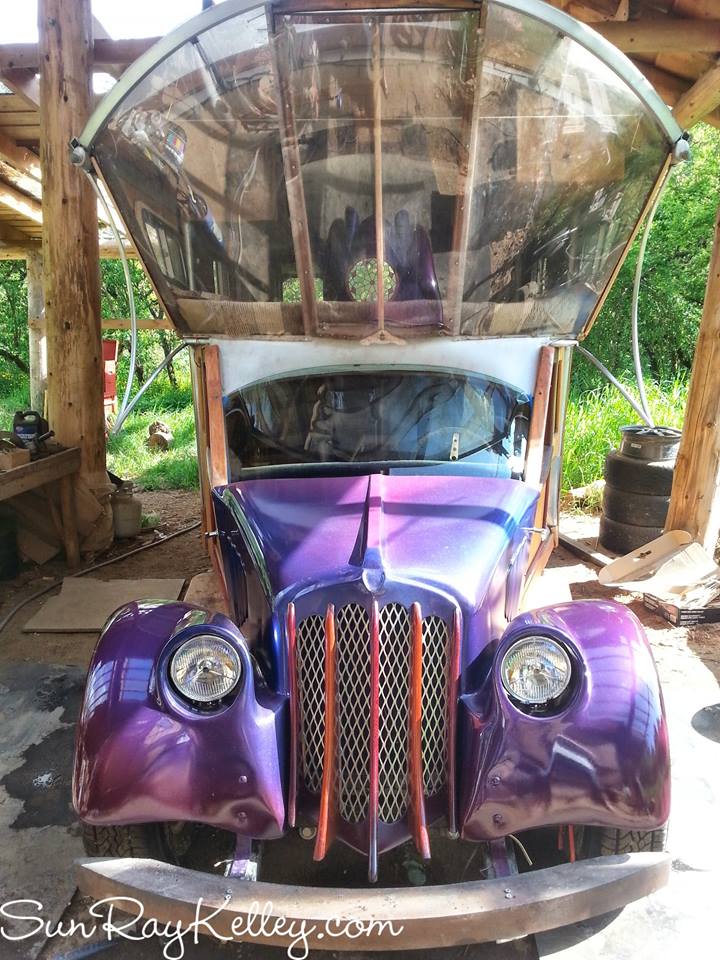
Here’s your chance to own a one-of-a-kind SunRay Kelley custom Gypsy Wagon! The canted walls and curved ceilings make this cedar-sided caravan feel very roomy. Read More …
At my Vancouver presentation of Tiny Homes on the Move, someone asked what kind of camping rig I had. Bearing in mind that most of my camping was in the desert or on beaches in Baja California, I had a VW bug modified for desert travel; then three different trucks, a 1983 4×4 Tacoma (not with the “Xtra Cab”), a 1987 Toyota Tacoma 4×4 with Xtra Cab, finally a 2008 Tacoma with Xtra Cab. I’ll describe these vehicles in that order.
Baja Bug
I bought this in the early ’90s from a guy who raced cars in the Baja 1000. It was called a pre-runner, so named because it was used to scout out the race in advance. Read More …
“SunRay Kelley’s human-electric hybrid SunRayzor bike is ready to ride. SunRay electrified his made-in-the-USA recumbent Catrike with a 72-volt Crystalyte hub motor and lithium-ion batteries. A custom-built rain shield and interchangeable windshield round out the package.”
Lots of SunRay’s creations — cob, straw bale, timber frameworks, stoves, saunas, yurts, and multiple inventions can be seen on his website: www.sunraykelley.com.
Here is an extremely well-documented build with plans of a beautiful vardo.
“This is my home-built trailer using classic and modern building techniques and style. Based on traveler’s and “gypsy” wagons from Britain and France as well as sheep wagons from the western U.S., I am keeping this to the absolute minimum in size and weight. I don’t plan to live in it full-time so it can be thought of a base camp. I have mulled it over for a very long time and was torn between this style and a teardrop design. Each have advantages but this just seems to suit me better…”
The Fortune Cookie was featured in Tiny Homes on the Move. Here are more examples of Abel Zimmerman’s wonderful work:
First: Wood creates its own pathways. I am only following as best I can.
Second: My work is about people. Every time I collaborate with somebody on a little house, some new “flowers” seem to bloom in the world. Despite the newness, I more often intend to build things that feel “magnetic” and familiar. If people appreciate it 50 years later, then I/we have done the right thing. Read More …
These came in the mail from Kurt Buetow just as we were finishing Tiny Homes on the Move, and I just dug them out.
Hi Lloyd,
As you know, I’m into these hanging chairs. In the forty years since I won the International Canvas Furniture Design competition in Tokyo, I’ve spent time in the woods and find it pleasing to select technology I can kind of deal with, like a hay wagon and bent wood and a ’70s-era electric tractor I charge with PVs.
I like the idea of shelter, but no more than you need. Feet on the ground, the side bows on this umbrella fold up so it becomes only nine feet wide. Nice place to enjoy the rain, there’s a hammock, and a cot, tables, and storage. Maybe somewhere else tomorrow.
Onward,
Kurt
Mode of Transport
This is how I move the rolling hang-out (’70s General Electric). The solar panels are mounted on a steel-wheeled McCormick Deering hay wagon running gear from the ’20s. In summer I tilt them east and west through the day.
The other day on my way down to Bolinas beach I met Jean Hervé, Sylvie, and Luka in the midst of a trip around the world. From their native France they shipped their rig to Nova Scotia, drove down to Florida and across the southern U.S. to California. They are now on their way to Mexico and Central America where they plan on staying a year or two. After that it’s down through South America for a few more years where they will end in Chile. From Chile they are back on a ship and heading to Asia for a few years, then they will make their way thru Russia and back to France eventually. Jean Hervé built this custom diesel-powered, all-wheel-drive, torsion-free subframe beast that will take you almost anywhere on the planet. The interior has beds, a kitchen, and a full bathroom and is built immaculately with space saving in mind. Read More …
“I put on the furring strips with the help of my friend Steven. These furring strips will allow for a ½″ gap behind the siding that will allow airflow to dry out any moisture. Rain screens, in my opinion, are the best way to side in the Northwest. Take advantage of airflow, whenever possible…”
Check out Travis Skinner’s website here; it’s rich in art, craft, and building. He lives in Olympia, Washington.
I have been seeing this van around for a few weeks and trying to catch up with the driver. I love these vans and wish California/U.S. Customs would relax some of their crazy import laws and allow some of these in. I finally found them in Bolinas today! This is Drew De Panacis and his friend Justin Artuso. They are on a surfing/rock climbing road trip from Vancouver, Canada and went as far south as Big Sur for surf and out to the sierras for rock climbing. They are slowly making their way back up to the great north and hitting as much good surf as they can along the way. The van is a 4×4 diesel and it has a veggie conversion kit on it and holds 35 gallons of oil. To get something like this in America, you’d really only have one option — a Sportsmobile — which start out in the $30-$40k range for a used one. These Delicas go from $5-$10K in Canada which makes them a lot more affordable to younger folks and people who don’t make a ton of money.
I was skating on the street one day and passed this striking greenhouse truck (for lack of a common descriptive phrase). It’s one of those things that you just GET when you see it. I stopped and talked to Justin Cutter, fellow skateboarder as well as gardener. This isn’t only one of the things you get when you see it, it’s one of those things you instantly LIKE. What a great idea! He takes it around to schools and teaches kids gardening.
My ex-husband and I built our home in the ’70s on a 1956 White truck, which cost $250. We used many recycled materials. Shipping crates became siding, discarded oak pallets and tiles became the table, etc.
It had a circulating toilet, double-paned Plexiglas windows and skylights, and a 30-inch porch at the rear. It had a 125-gallon water tank and a 60-gallon propane tank — self-contained. It’s solidly built and runs great!
There were two full-size bunks for the four kids. The upper bunk had been removed when these photos were taken. The spinet piano can barely be seen.
Studs were linked at the bottom with ¼-inch steel angle. It prevented disaster when one time someone drove into the side of the house truck. The driver totaled his car; we only have to replace a bit of siding.
The window design was determined by the size of the discarded Plexiglas scraps, and inspired by bathroom windows in Golden Gate Park in San Francisco.
We bolted three metal baffles between the stove and walls, staggering the bolts so as not to transfer the heat. The stove could be fully fired up and the wall behind it would still be quite cool.
I learned all my carpentry and building skills working on this truck. One day while driving myself, the porch railing got caught in something, ripping it half off, and it was sitting on the ground. What to do? I pulled out some tools and reattached it on the spot before driving away.
In 1973 we published Shelter, which turned out to be station central for people interested in creating their own homes. Now, in the 21st century, we continue this dialog here online on shelter, carpentry, homesteading, gardening, and the home arts with this blog. We hope you will join us and contribute.